
What actually happens on air con install day
A blow-by-blow account of a typical UK domestic air conditioning install day - arrival, drilling, pipework, commissioning. What to prep and what to expect.
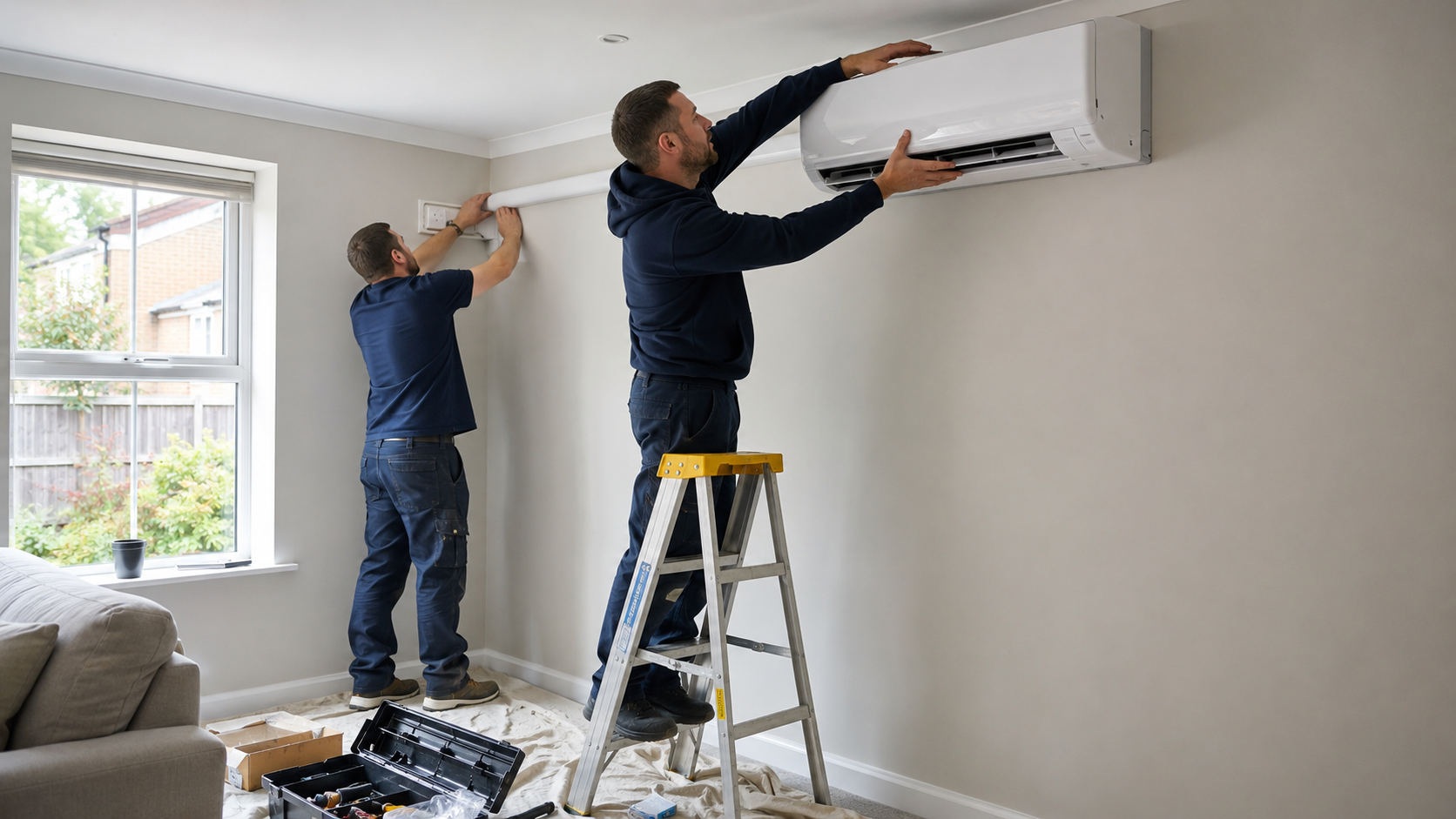
For most single-room installs it is one day, two engineers, and around six hours of noise. Here is exactly what happens.
The night before
Two prep jobs:
- Clear the room where the indoor unit will go. Everything within a metre of the install spot - furniture, wall art, curtains - moved out or covered with a dust sheet.
- Clear the route the outdoor pipes will take. If pipes run through a loft or a cupboard, empty the shelves or boxes near the run.
Nothing else needs doing.
8am - arrival
Two engineers, one van. They knock, walk the job, confirm the outdoor unit position, confirm the pipe route, and lay dust sheets in the install room.
Expect ten minutes of “briefly walking through the plan” before any tools come out. This is normal and useful - they may spot an easier route than the survey suggested.
Then they ask where the mains water tap is (for the vacuum pump condensate) and where the electrical consumer unit is (for the fused spur).
9am - the drilling starts
The first drill is the wall penetration for the refrigerant pipes. A 65mm core drill, about ten minutes, one loud hole through your wall.
If your wall is solid brick expect fifteen minutes and more dust. If it is cavity wall, five minutes and a much cleaner hole.
They will have masked the wall with tape and a shroud - dust is contained but not zero.
9.30am - mounting the indoor unit
The wall mounting plate goes on first. Levelled, drilled into brick or masonry, secured. Then the indoor unit clips to the plate.
The pipework tails from the unit are still uncut at this point - they come pre-formed with insulation, and get shortened to fit the exact pipe run.
10.30am - outdoor unit and pipe run
The outdoor unit goes on wall brackets (or a ground stand, depending on the site). Rubber isolation pads under the mounts to stop vibration transmitting into the wall.
The refrigerant pipes get run between indoor and outdoor units - either externally along the wall, or internally through the loft or a cupboard. The refrigerant pipes are two thin copper tubes wrapped in white insulation. They look tidier than most people expect.
Cable ties every 50cm. Any external run gets a UV-resistant plastic trunking to hide the pipes.
12noon - electrical hookup
A fused spur on your consumer unit. If your consumer unit has a spare 20A slot, this is a ten-minute job. If it needs a new consumer unit (rare, older houses) that is a separate visit by an electrician - the survey should have flagged this.
Every unit needs an isolator switch next to the outdoor unit. That is a small waterproof box mounted on the wall.
1pm - lunch
Half an hour off. This is the good time to make a cup of tea.
1.30pm - vacuum and refrigerant
The most important part of the install. The engineers connect a vacuum pump to the pipe run and pull all air out. This takes 20 to 40 minutes and removes any moisture from the system.
Then they weigh the refrigerant charge and release the exact amount into the system. This is what F-Gas certification exists to regulate.
Skip this step and the system leaks in six months. Rush it and the compressor fails in year three. A good installer takes their time here.
2.30pm - commissioning
They power the system up, run it through cool mode and heat mode, check pipe temperatures, check compressor amp draw, check condensate drainage.
Ten minutes of “cool air, warm air, cool air” tests. Then they demo the remote control and the app if there is one.
3.30pm - tidy up
Dust sheets rolled up, wall dust vacuumed, external trunking cleaned. They leave the paperwork - commissioning certificate, warranty registration, service recommendations.
Small talk about how the unit works, when to service it, what to watch for.
4pm - done
That is the whole day for a single-room install. Multi-room installs run two to three days on the same rhythm.
Two things to expect that first-time buyers do not
- The outdoor unit fan pulse when it runs. Not loud, but audible if you sit next to it.
- A faint hum from the indoor unit for the first week as the system settles.
Both fade. Neither is a problem.
Get three quotes for an install day like this
Fill in the quote form and we match you with three vetted North West installers. Every one runs their install days like the above.
Ready for a real quote?
Get up to 3 fixed prices from vetted North West installers.
More on Guides
Air conditioning in a flat: what leaseholders need to know
Flats overheat worse than houses and carry the tightest rules on fitting cooling. Here is what your lease says, where the condenser can go, what freeholder consent costs, and the options when there is no outdoor space at all.
What temperature should you set your air conditioning?
Setting 16C does not cool a room any faster, and it costs you for the privilege. Here is the setpoint that works in a UK summer, what each degree adds to the bill, and when dry mode beats cool mode.
Air conditioning for pets: keeping dogs, cats and rabbits cool in a UK summer
Fans do far less for a panting dog than they do for you. Here is what heat does to UK pets indoors, which room to cool, what it costs to run while you are out, and when a fitted unit is worth it.