
Air conditioning for pets: keeping dogs, cats and rabbits cool in a UK summer
Fans do far less for a panting dog than they do for you. Here is what heat does to UK pets indoors, which room to cool, what it costs to run while you are out, and when a fitted unit is worth it.
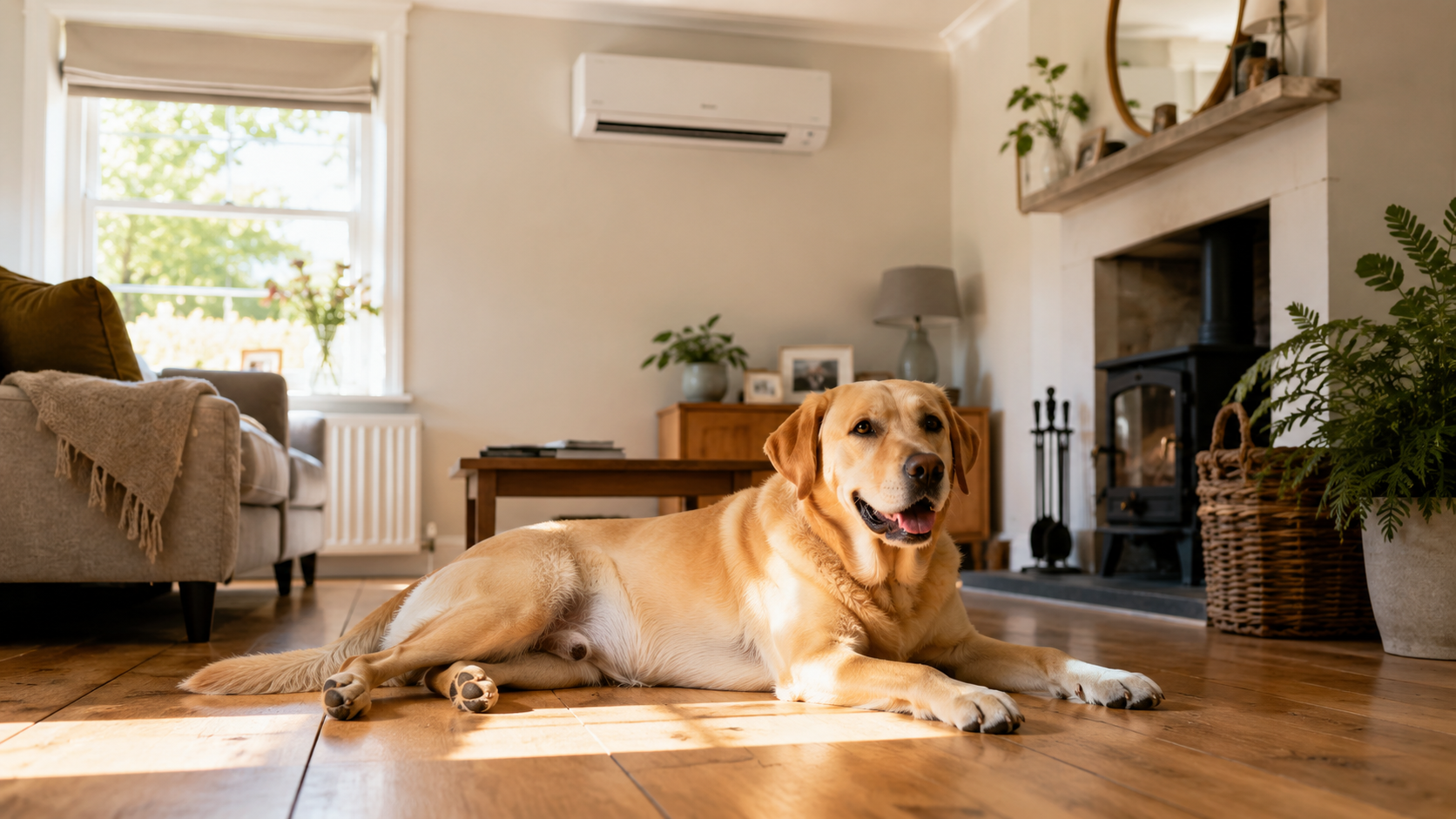
The dog has moved to the kitchen tiles for the fourth night running. The cat is flat out under the bed and has not eaten since breakfast. It is 9pm, the house is still holding 27C upstairs, and you are wondering whether the fan you bought last week is doing anything for either of them.
It is not doing much. That is the part most owners get wrong, and it is worth understanding before you spend money on the wrong fix.
Why fans work less well for animals
A fan does not cool air. It moves air across your skin, sweat evaporates, and you feel cooler. The cooling comes from your sweat.
Dogs and cats barely sweat. What little they manage comes through the pads of their feet. A dog sheds heat by panting, which is evaporation from the tongue and airway rather than the skin. Moving air past a panting dog helps a little, and helps less as the air gets warmer and more humid. That is why a fan that makes you comfortable at 28C can leave the dog no better off.
The temperatures that matter
Dogs start struggling once the ambient temperature sits in the mid-20s, and the risk climbs sharply from there. Flat-faced breeds like French bulldogs and pugs are worst placed, because the airway that does the panting is the airway that was bred short. Overweight dogs, thick-coated breeds, elderly dogs and puppies all cope badly. UK veterinary work on canine heatstroke keeps making the same point: owners here underestimate it, because our hot spells arrive suddenly and dogs get no chance to acclimatise.
Cats handle heat better. They sleep through the worst of it, seek out cool floors and reduce activity. Kittens, elderly cats and long-haired breeds are the ones to watch.
Rabbits and guinea pigs are the most heat-vulnerable pets in a British home, and the ones owners worry about least. Welfare guidance puts rabbits in trouble from around 25C, and they cannot pant to cool themselves at all. An indoor hutch in a conservatory on an August afternoon is a genuine danger. Our guide to air conditioning in a conservatory explains why that room runs so far ahead of the rest of the house.
A typical UK bedroom holds 26C to 28C through the night after three consecutive hot days, and upstairs rooms in a modern insulated house hold it longest.
What a fitted unit changes
Two things, and the second one is the one people forget.
It holds a set temperature. A split system runs the compressor hard until the room reaches setpoint, then throttles back and maintains it. The room stops climbing through the afternoon while you are at work.
It takes moisture out. A domestic split pulls roughly one to two litres an hour out of a room while it cools. Drier air makes panting work better, so the humidity drop matters more to a dog than to you.
Set it to 22C to 24C. There is no benefit in chilling a room to 18C, and a big gap between the cooled room and the rest of the house is worse for an animal moving between the two.
Which room to cool
Cool the room the animal settles in, which is often not the room you would pick. For most households that is the kitchen, utility or hallway, because hard floors stay cooler. For cats it tends to be wherever is darkest and lowest. Watch where they go for a week before you commit to a position on the wall.
If the pet follows the family, the living room is the sensible choice, and it works for everyone else too. We set out the order most families end up choosing in which rooms to prioritise.
Leave the door to the cooled room propped. An animal shut in cannot move if the room gets uncomfortable, and one shut out gets no benefit at all.
Running it while you are out
This is the question that decides it for most owners. A 2.5kW split cooling a bedroom or small living room costs 18p to 24p an hour on a hot day, from our cost per hour guide. A nine-hour working day is £1.60 to £2.15. Once the room reaches setpoint the unit idles at 1p to 2p an hour, so a merely warm day lands lower.
Almost every current unit has app control, so you can start it from the train rather than running it all day on a timer. Bringing the room down before the afternoon peak costs less than chasing the temperature back down at 6pm.
One caution. Air conditioning is a comfort system, not a life-support system. It can trip, and the power can go off. If a pet cannot tolerate heat at all, the cooled room still needs shade, water and airflow as a backstop.
Noise, draughts and fur
Position the indoor unit so the airflow crosses the room rather than blowing onto the bed or basket. Cats in particular will simply relocate.
Noise matters more for pets than for people. A bedroom-grade unit runs at 19dB to 22dB on its lowest fan speed, quieter than a fridge. Ask for the low-fan figure rather than the headline rating. Our quietest units guide covers which models hold up. Outside, keep the condenser clear of a dog run or kennel.
Pet hair loads the indoor filters faster than anything else in a house. The mesh filters behind the front flap slide out and rinse under a tap. With a shedding dog, do it monthly through summer.
What it costs to fit
A single room split is £1,800 to £2,800 fitted. Two rooms on one outdoor unit is £3,500 to £5,500, and three rooms £5,500 to £8,500. The full brackets sit on our prices page.
For a dog that lives on the ground floor, one well-placed unit is usually the whole answer. It earns its keep in winter too, since the same unit runs as a heat pump and warms that room at roughly a third of the cost of electric heating.
Get quotes for a pet-friendly install
Tell us on the quote form which room the pet uses, what flooring it has, and whether noise is a concern. Installers can then specify a quiet unit and a sensible airflow direction rather than defaulting to the easiest wall. Three fixed quotes back within 24 hours from vetted North West installers.
Or check the prices page for a rough bracket first, or email us a question if you want to talk it through before requesting quotes.
Ready for a real quote?
Get up to 3 fixed prices from vetted North West installers.
More on Guides
Air conditioning in a flat: what leaseholders need to know
Flats overheat worse than houses and carry the tightest rules on fitting cooling. Here is what your lease says, where the condenser can go, what freeholder consent costs, and the options when there is no outdoor space at all.
What temperature should you set your air conditioning?
Setting 16C does not cool a room any faster, and it costs you for the privilege. Here is the setpoint that works in a UK summer, what each degree adds to the bill, and when dry mode beats cool mode.
Does air conditioning add value to a UK home?
Nobody can point to a reliable percentage uplift, so here is what air conditioning really does to a UK house sale, which homes gain most, and the install choices that protect value rather than dent it.